


REQUEST A QUOTE OR MORE INFORMATION
Fill out the form below for someone to contact you reguarding quotes and questions.Or visit our contact page for general contact information.
News

Mar. 12, 2025
Agricultural gearboxes transfer power from tractors, engines, motors, or PTO systems to the working components of farm machinery. Depending on the application, they can change speed, torque, rotation direction, and shaft orientation.
Because agricultural machines work under different loads, the correct gearbox should be selected according to machine type, power, torque, gear ratio, shaft configuration, mounting position, and operating environment.
Bevel gearboxes transmit power between intersecting shafts, commonly at a 90-degree angle. Their compact structure makes them widely used in PTO-driven agricultural machinery.
Typical applications include rotary cutters, rotary mowers, rotary tillers, combine harvesters, fertilizer spreaders, grain handling machinery, and post hole diggers.
For cutting equipment, view our Rotary Cutter Gearboxes.
Worm gear reducers use a worm screw and worm wheel to achieve a relatively large reduction ratio in a compact structure. They suit applications requiring lower output speed and increased torque.
Common uses include feed handling equipment, agricultural conveyors, mixers, and auxiliary farm machinery. Selection should consider ratio, load, duty cycle, thermal conditions, and lubrication.
Parallel shaft gearboxes use input and output shafts arranged parallel to each other. They provide efficient transmission where the machinery does not require a major change in shaft direction.
They are often used in conveyors, harvesting equipment, grain handling systems, and feed machinery where stable torque and continuous operation are important.
See our Grain Transportation Gearboxes.
Helical gears use angled teeth that engage gradually, helping provide smooth transmission and reduced vibration. They can be used in grain conveyors, feed systems, mixers, agricultural processing equipment, and other machinery requiring continuous operation.
Planetary gearboxes use a sun gear, planet gears, and a ring gear to provide high torque density in a compact structure. They are suitable for high-load agricultural equipment, harvesting machinery, seeders, and drive systems where installation space is limited.
Spiral bevel gearboxes use curved bevel teeth to provide smooth right-angle transmission. Applications include rotary cutters, tillers, harvesters, mowers, grain handling equipment, and other PTO-driven implements.
Input speed, output speed, torque, shaft arrangement, and working load should be confirmed before selection.
Helical bevel gearboxes combine helical and bevel gearing. They suit equipment requiring a direction change together with stable torque, efficient transmission, and compact installation.
They may be used in conveyors, processing equipment, harvesting systems, and other agricultural transmission systems.
Non-synchronous transmissions are manual transmission systems without synchronizers. They are mainly associated with tractors and older agricultural vehicles rather than PTO-driven implements.
For modern implements, bevel, worm, parallel shaft, PTO, or application-specific gearboxes are generally selected according to the working mechanism.
Gearbox structure is important, but selection should also start from the machinery it will operate.
Rotary cutters, brush cutters, rotary mowers, and flail mowers need gearboxes capable of transferring PTO power to rotating blades while handling changing cutting resistance and impact loads.
Key parameters include tractor or PTO power, 540 or 1000 RPM input, gear ratio, output torque, shaft specifications, blade load, and mounting dimensions.
Explore GTM Rotary Cutter Gearboxes for cutting and mowing equipment.
Rotary tillers require stable high torque because the blades continuously work against soil resistance. Actual load varies with tractor power, working width, soil condition, tilling depth, PTO speed, and rotor speed.
View our Rotary Tiller Gearboxes for different tiller transmission configurations.
Grain augers, screw conveyors, belt conveyors, bucket elevators, and unloading systems often operate for long periods and require stable torque.
Important considerations include continuous-duty performance, output torque, conveyor speed, gear ratio, sealing, dust protection, bearing durability, and maintenance.
Explore GTM Grain Transportation Gearboxes for grain handling and storage equipment.
Combine harvesters use transmissions in cutting, conveying, threshing, cleaning, and unloading systems. Different positions can require different ratios, torque capacities, shaft arrangements, rotation directions, and mounting configurations.
See our Combine Harvester Gearboxes for harvesting machinery applications.
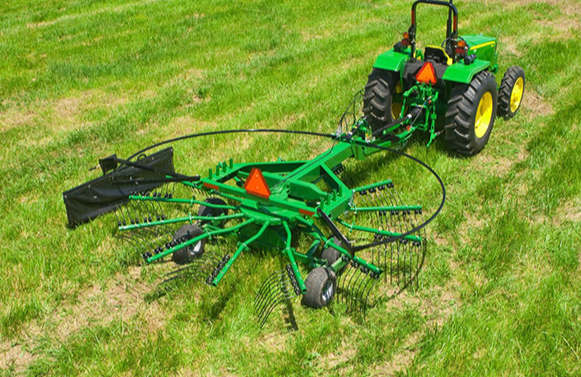
Agricultural gearboxes are also used in balers, feed mixers, fertilizer spreaders, manure spreaders, hay rakes, sprayers, potato harvesters, post hole diggers, snow blowers, and other equipment.
Browse Other Agricultural Gearboxes for additional applications.
First identify what the gearbox must drive. Rotary cutters need reliable transmission under changing cutting loads, tillers require high torque, grain conveyors require stable continuous operation, and harvesters may need several gearbox configurations.
Terrain, soil condition, crop residue, and operating cycle can also affect transmission load.
The gearbox should handle both normal working loads and temporary peak loads. Provide tractor horsepower or motor power, PTO power, rated torque, expected peak torque, and implement type when requesting a gearbox.
Horsepower alone is not enough because machines with similar power can place different loads on the gearbox.
Many PTO-driven machines use 540 RPM or 1000 RPM input. The gearbox changes this input to the speed required by the working mechanism.
Gear Ratio = Input Speed ÷ Required Output Speed
The final ratio should also consider torque, blade or rotor speed, load, and transmission layout. If a standard ratio does not fit the machine, a customized ratio may be needed.
Confirm input and output shaft diameter, spline specification, shaft length, keyway, rotation direction, shaft orientation, and connection method.
For OEM projects or replacement applications, a gearbox drawing, sample, or dimensional information can improve model matching.
Check mounting holes, center distance, housing dimensions, shaft position, installation angle, and available space. Correct mounting compatibility can reduce redesign work when integrating the gearbox into existing machinery.
Gear machining, bearings, alignment, lubrication, and assembly quality can affect transmission efficiency, noise, temperature, and service life.
Agricultural gearboxes may operate around dust, mud, water, crop residue, fertilizer, vibration, and temperature changes. Suitable sealing and lubrication are therefore important.
Grain handling equipment often needs strong dust protection and continuous-duty reliability, while cutting machinery may require greater resistance to impact loads.
Maintenance affects machine downtime and operating cost. Consider lubrication access, oil seal replacement, bearing replacement, spare parts availability, and service access.
A standard gearbox may be suitable when the ratio, power, shaft arrangement, and mounting dimensions already match the machine.
Customization may be required for:
Special gear ratios
Different input or output shafts
Custom splines
Modified mounting dimensions
Specific rotation directions
Application-specific torque requirements
GTM can evaluate gearbox configurations based on machinery type, operating parameters, shaft requirements, and installation conditions.
There is no single agricultural gearbox suitable for every farming machine. Bevel, worm, parallel shaft, helical, planetary, spiral bevel, and other designs have different transmission characteristics.
The correct choice depends on both gearbox structure and actual application. Power, torque, PTO speed, ratio, shaft configuration, mounting position, working environment, efficiency, and maintenance should be evaluated together.
If you are developing a new agricultural machine or replacing an existing gearbox, send GTM your application, power, speed, ratio, shaft, mounting, and operating requirements.
We can help identify a suitable existing gearbox or evaluate a customized transmission configuration.
Contact GTM for Gearbox Selection & Quotation
GEARBOX MANUFACTURER
Zhejiang GTM was established in 1997, which located in economic development zone of Wenling city, southeast of China.
GTM agricultural gearbox products include spiral and straight bevel gearbox, cylinder gear speed reducer, worm reducer, and transmission case etc, which are widely used in various fields as Rotary cutter, grain transportation and storage equipment, Rice harvester,baler,hayrake, rotary tillers, pesticide sprayers, fertilizer spreaders, potato harvester, post-hole diggers, combine harvester,snow-blowers, garden machines and oil exploitation fields etc.
350000+
Annual quantity over
1997
Company establishment
6
Invention patents
56
Utility model patents
REQUEST A QUOTE OR MORE INFORMATION
Fill out the form below for someone to contact you reguarding quotes and questions.Or visit our contact page for general contact information.